

Brand History – Hook-Ups
The flashy skateboards, caps, and (especially) t-shirts and hoodies from Hook-Ups are legendary. To find out why skater Jeremy Klein's brand was so far ahead of its time in the 90s, we spoke to an expert on the occasion of our Hook-Ups Drop: Taran (36) from The Ishincroyable from Munich, who is not only a busy vintage connoisseur but also a Hook-Ups collector.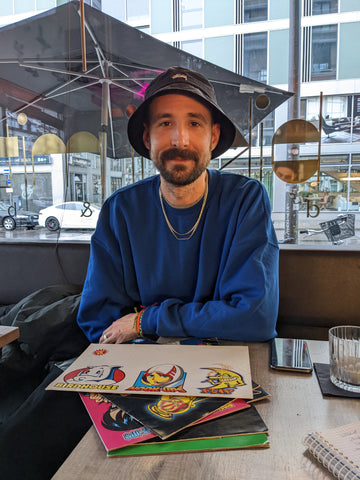
Taran (The Ishincroyable)
Double Double Vintage: Do you remember when you first noticed Hook-Ups?
Taran: It was on a Tech Deck fingerboard! Around 1999/2000, everyone in our school had a fingerboard. And Hook-Ups stood out the most of all the labels because of its graphics. Because they had these anime graphics.
I started skating back then, and we always made a pilgrimage to Goodstuff, which was a legendary skate shop here in Munich. They also had Hook-Ups skate decks there, but they were unaffordable for me. I always shopped in the reduced section (laughs)!
What I found so cool about Hook-Ups back then were the graphics: I skated. And I enjoyed watching anime and reading manga. Akira and Cowboy Bebop, for example. And Hook-Ups perfectly closed this gap between anime and skating.
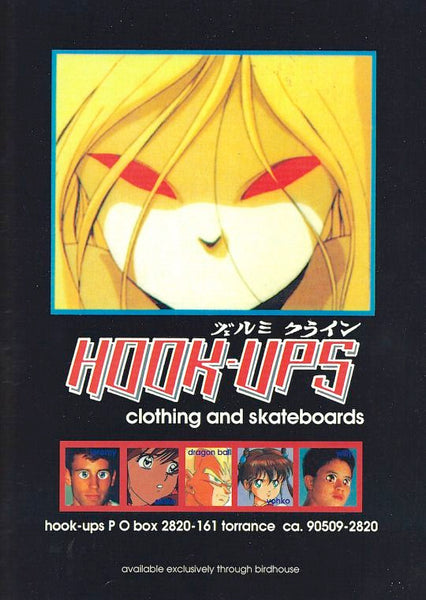
Old Hook-Ups ad
Double Double Vintage: I actually knew the decks around 2000, but no merch. Was the clothing even available in Germany back then?
Taran: The merch was sold here in Germany. But it was quite expensive. Too expensive for kids anyway. And maybe too expensive for adults to skate in. You might have been more likely to watch skating in your Hook-Up shirt (chuckles).
Double Double Vintage: When did you first own a piece of clothing from Hook-Ups?
Taran: Actually, never until "now." So, only in recent years, when I could catch up on this passion because I have a bit more money now than when I was younger.
Double Double Vintage: Can you tell us a bit about the history of Hook-Ups?
Taran: Sure. So Jeremy Klein, the mastermind behind Hook-Ups, was first a skater for World Industries and then in the Birdhouse Crew. You know them, for example, from the "Birdhouse Projects" videotape. The only video, by the way, where Tony Hawk ever street skated instead of in the halfpipe.
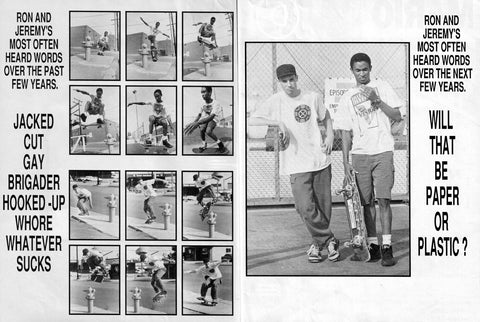
Jeremy Klein did the art direction at Birdhouse and then founded Hook-Ups in the mid-90s. But don't hold me to the exact year. Hook-Ups initially only had T-shirts. You know, there was a lot of "do it yourself" in it, as often in skating. Printing shirts was simply easier than producing decks. Jeremy Klein also benefited from Tony Hawk's infrastructure in all this. (Taran places a stack of magazines on the table)
These are old catalogs from Birdhouse Distributions. They distributed Birdhouse, Flip, and Hook-Ups. You can tell the first catalogs by the fact that they weren't numbered yet. (Taran pulls out a newer catalog) This is a later catalog, where a new artist eventually took over at Hook-Ups. He initially adopted Jeremy Klein's first anime shirt "logic," but later changed and Americanized it.
Double Double Vintage: What do you mean by "Americanized" in this case?
Taran: The characters' eyes got even bigger. And all proportions in general: eyes, breasts, and so on. Jeremy Klein, at the beginning of Hook-Ups, drew heavily visually from real anime (opens a page in the catalog).
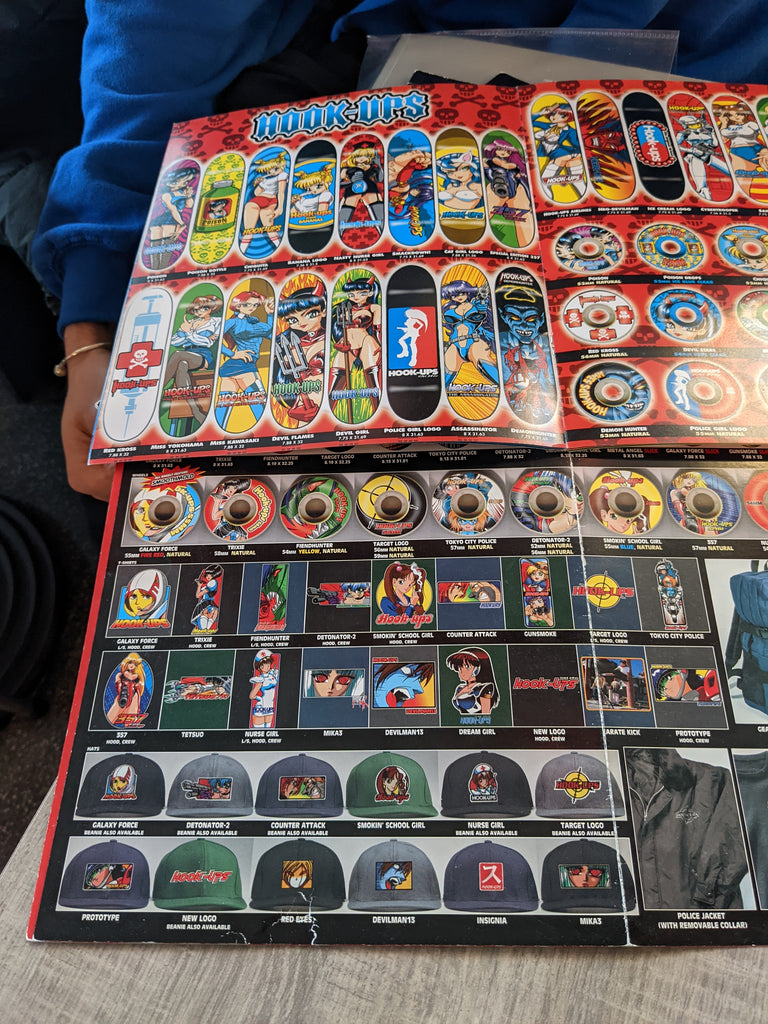
(Taran's vintage Hook-Ups catalog)
Double Double Vintage: Ah yes. This looks like Battle Angel Alita. And the graphic of "Tokyo City Police" here in the catalog is actually "Dominion Tank Police" mixed with "Gunsmith Cats."
Taran: Exactly, for example. And when Blitz Distribution took over the distribution of Hook-Ups in 2002, the look generally became more detached from the real anime that Jeremy Klein had previously referenced. That was sometimes typically American. An example is the allusion to the "Hooters" girls from the fast-food chain.
Those were already the shirts with the white size tag (size label in the neck, editor's note) with a cross on it. Before that, there was the Kanji tag, around 1996. The tag with the bunny ears came in 1997. And from 1998 to 1999 came the crosshair tag with the target. Those were a bit wider. The skull tag was introduced in 2001/2002. And (reaches into his neck to show the label of his Hook-Ups shirt) in 2007, the shirts had the lettering on them. Oh, and right at the beginning, the T-shirts were printed on Anvil blanks without their own tags, just like with Birdhouse. And the hoodies were initially made of "Soft Fleece."
Double Double Vintage: How can you tell if Hook-Ups shirts are fake?
Taran: The size tag is an indicator. The era with the skull label is faked the most. Those are the ones with the skull on a red cross. If the tags don't have a size indication, they're fake. And there are no backprints on real Hook-Ups shirts. The fakes, however, often have designs on the back. And you can also tell by the collar: it's often thinner on fakes.
Double Double Vintage: To be honest, I was surprised when I recently saw that Hook-Ups is still active. For a long time, the brand was somewhat "irrelevant." Why do you think Hook-Ups is so popular again now?
Taran: The shape of the shirts certainly plays a role. It's always nice and boxy. And the quality and cotton of the old pieces are great. And of course, it also helps when a Travis Scott or Jonah Hill wears Hook-Ups in public. For me, the time when I skated myself simply has a nostalgia factor. That was going out with friends, sharing Lipton Ice Tea... that's another factor.
And today, skating is also much bigger. Kids are coming up now who see old and new graphics, and Hook-Ups still stands out.

Excerpt from an old Hook-Ups catalog (from Taran's archive)
Double Double Vintage: How does Hook-Ups manage to still stand out today?
Taran: It's like in the Marvel universe: there are different characters in the graphics. You can collect the stuff. And the fact that the graphics are from anime also plays a role. The aesthetic simply has a hype. These are still the freshest graphics.
World Industries, for example, also has cool graphics with Flameboy and Wet Willy. But that just repeats itself. Hook-Ups is aesthetically more beautiful. I also don't like it when there's too much going on on shirts. These small graphics are cooler. It's also getting harder to find old Hook-Ups pieces now. The joy is even greater when you find one for a reasonable price. You can also really dive into Jeremy Klein's creative universe with the motifs.
The graphics also have a shock factor. Of course, there's the sexualized aspect, but also things like alcohol and smoking: people in Europe are less bothered by that, but in the U.S.A., it's provocative. This counter-culture idea from skating still comes through. Also with Flip Skateboards: a graphic with a crescent moon snorting coke is somehow punky.
Double Double Vintage: In your opinion, does the "Hook-Ups" brand overshadow Jeremy Klein's legend as a skater?
Taran: I never really celebrated Jeremy Klein's skate style. It wasn't very technical. But it was very courageous. He just did his own thing. For example, there's the "Destroying America" video: they built a mini ramp in front of a bus stop, prepared the bus stop, and grinded on it.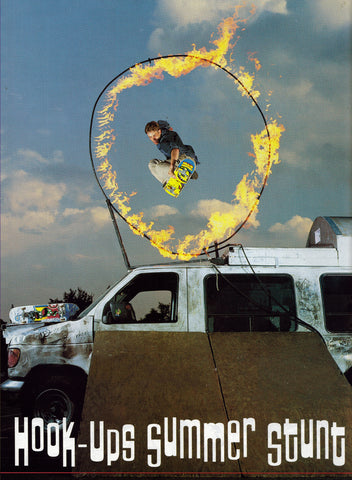
They made things skateable that you usually can't skate on. Like a neon sign from a fast-food restaurant, for example. Those weren't the craziest tricks, but they put on a great show with balls of steel.
While Rodney Mullen did an "Impossible Flip" and was the most technically amazing guy, Jeremy Klein rode up to the rail. Grinded. And came down. He really embodied that old-school skate style. The main thing was to take a spill.
Double Double Vintage: Cool, thanks for the interview!
PS: You can now get deadstock Hook-Ups shirts in our shop: Better be quick!
You can also get more memories of 90s and early 2000s skate style in episode 16 of the "Vintage am Mittag" podcast, which Taran co-hosts:
Comments
-
Liquid error (snippets/article_comments line 29): include usage is not allowed in this context
Liquid error (snippets/article_comments line 29): include usage is not allowed in this context
Liquid error (snippets/article_comments line 29): include usage is not allowed in this context
Liquid error (snippets/article_comments line 29): include usage is not allowed in this context
